The End of Dickie’s Skull

Regular readers will know that I’ve been on the trail of Dickie’s Skull for a while. A staple of books about ghosts and legends in the Peak District, the human skull sat on a windowsill at Tunstead Farm in Derbyshire for several centuries. Accounts differ of how and when Dickie (or Dickey) was found, and who exactly he was but most people agreed that if the cursed cranium was removed from its favoured spot or compromised in any way, terrible things would happen. The legend peaked in the 1800s when Dicky famously scuppered the building of a nearby railway. The story made it into the national press and there was a poem written about Dickie’s Skull, and even a play.
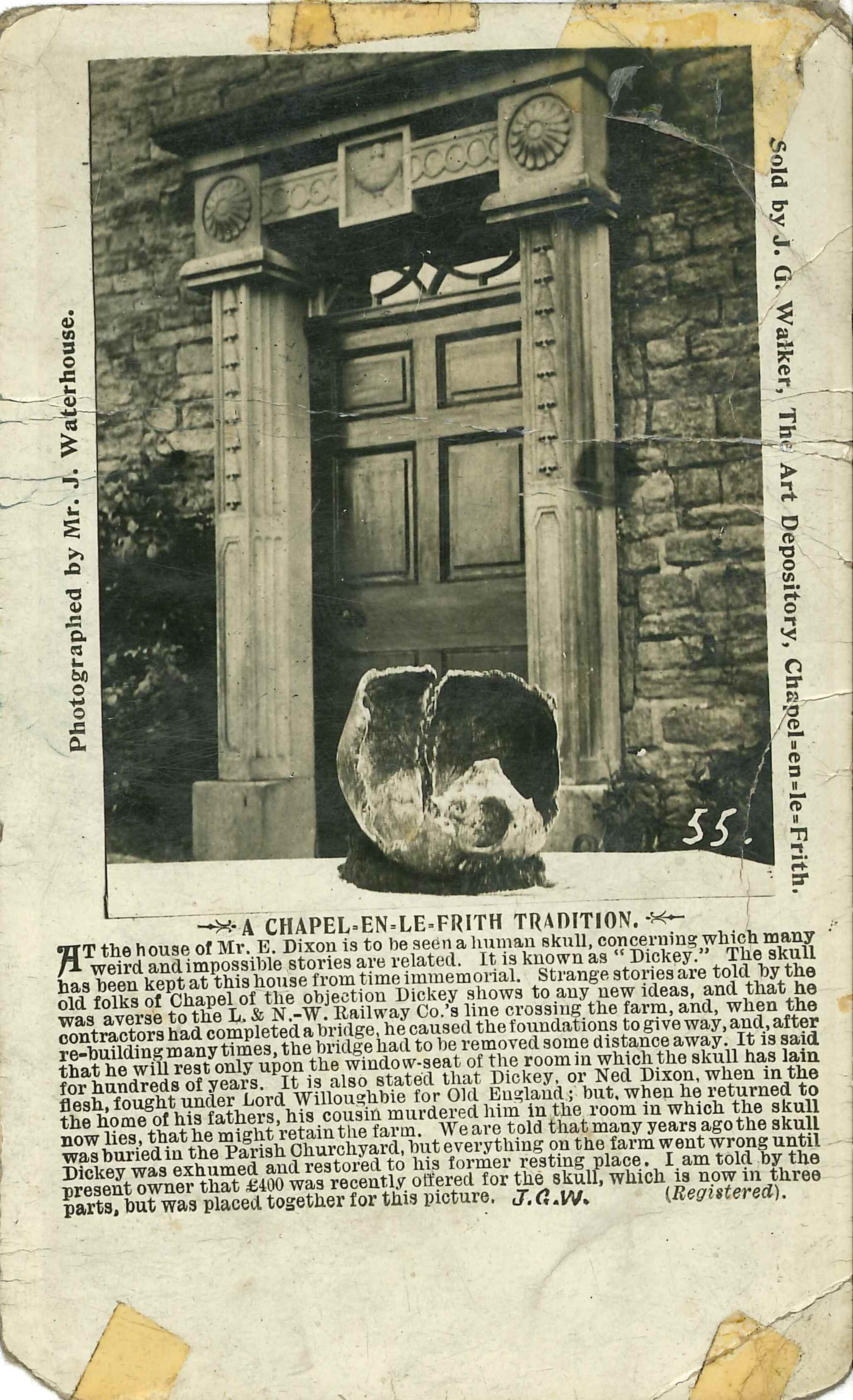
Courtesy of Buxton Museum and Art Gallery

On the trail of ghouls and goblins in and around the Peak District for many years, Dickie was a clear culprit for my investigations. The area around Tunstead Farm was already hot with accounts of monstrous wild cats and mysterious lights in the sky. Imagine then my disappointment when Dickie was not home, and the current residents of the farm knew nothing about the skull. And most strikingly, he had been removed without any obvious calamity.

A tip off diverted me to St. James’ Church in nearby Taxal, where Dickie had been given a Christian burial, and the curse laid to rest. However, it seems this fact may have gotten mixed up with the burial of an arm belonging to a man involved in a railway accident. I’d been sent on a wild goose chase (Wild skull chase? Wild arm chase?) As diversions go, Taxal was a lovely and atmospheric little place to visit, and apparently has a haunted house unconnected to Dickie, so I was okay with it.
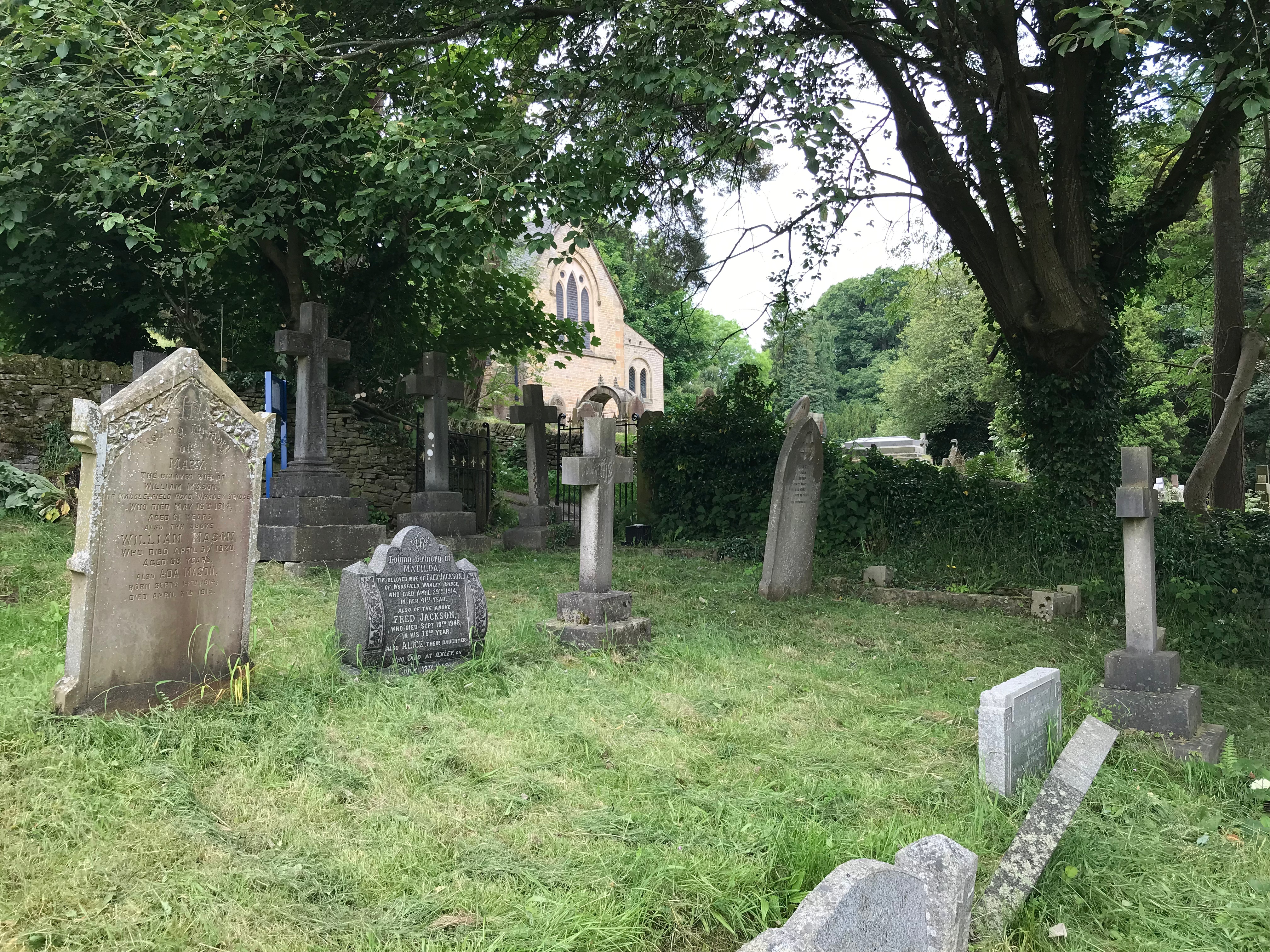
Wandering around a churchyard, looking for Dickie

But the trail is still cold and I can only conclude that Dickie’s eventual fate is as mysterious as his origins. However, I was thrilled when Dr. David Clarke got in touch to put a little more flesh on the bones, pun intended. David is one of the UK’s leading authorities on legends and folklore and I’d already read some of his books and seen him on the telly.

For starters, David drew my attention to his 1998 thesis on the tradition and folklore of the severed human head in the British Isles, The Head Cult, in which he describes the notion of the guardian skull or screaming skull. It turns out that Dickie is only one of many grotesque talismans, placed on hearths or windowsills to protect homes in a time when superstition was more prevalent than science. David’s investigation into Dickie’s Skull is considerably more accomplished and scholarly than mine, and I recommend you read it for yourself online here. Pages 369-379 being the most relevant.

It does seem evident that Dickie was laid to rest a long time before me or even David strolled into Tunstead. Even ghost hunters in the 1980s discovered an absence of Dickie. Local historian Margaret Bellhouse confirmed to David in 1993 that the owners of the farm got rid of the skull because they were fed up of people turning up to see it.
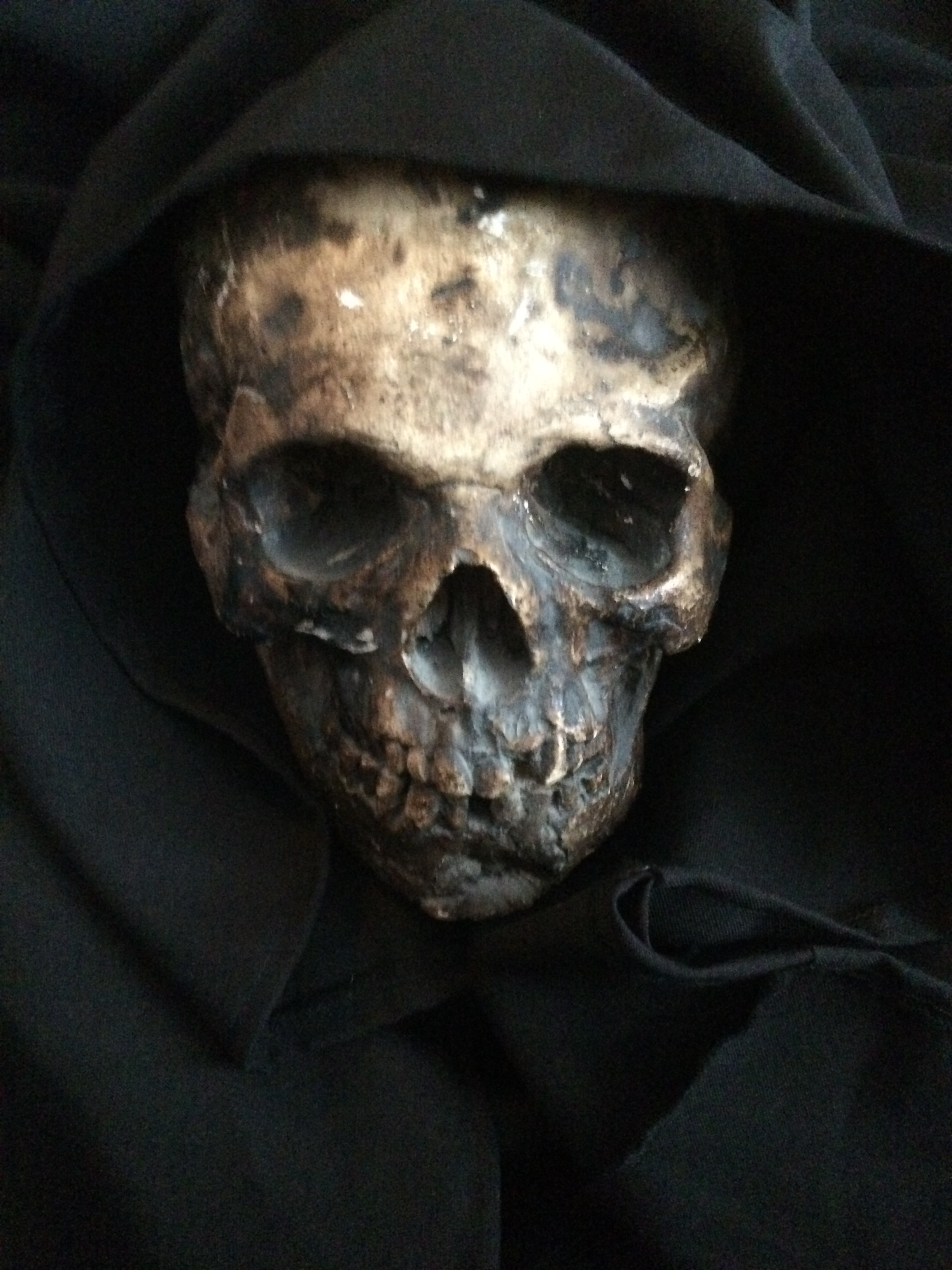
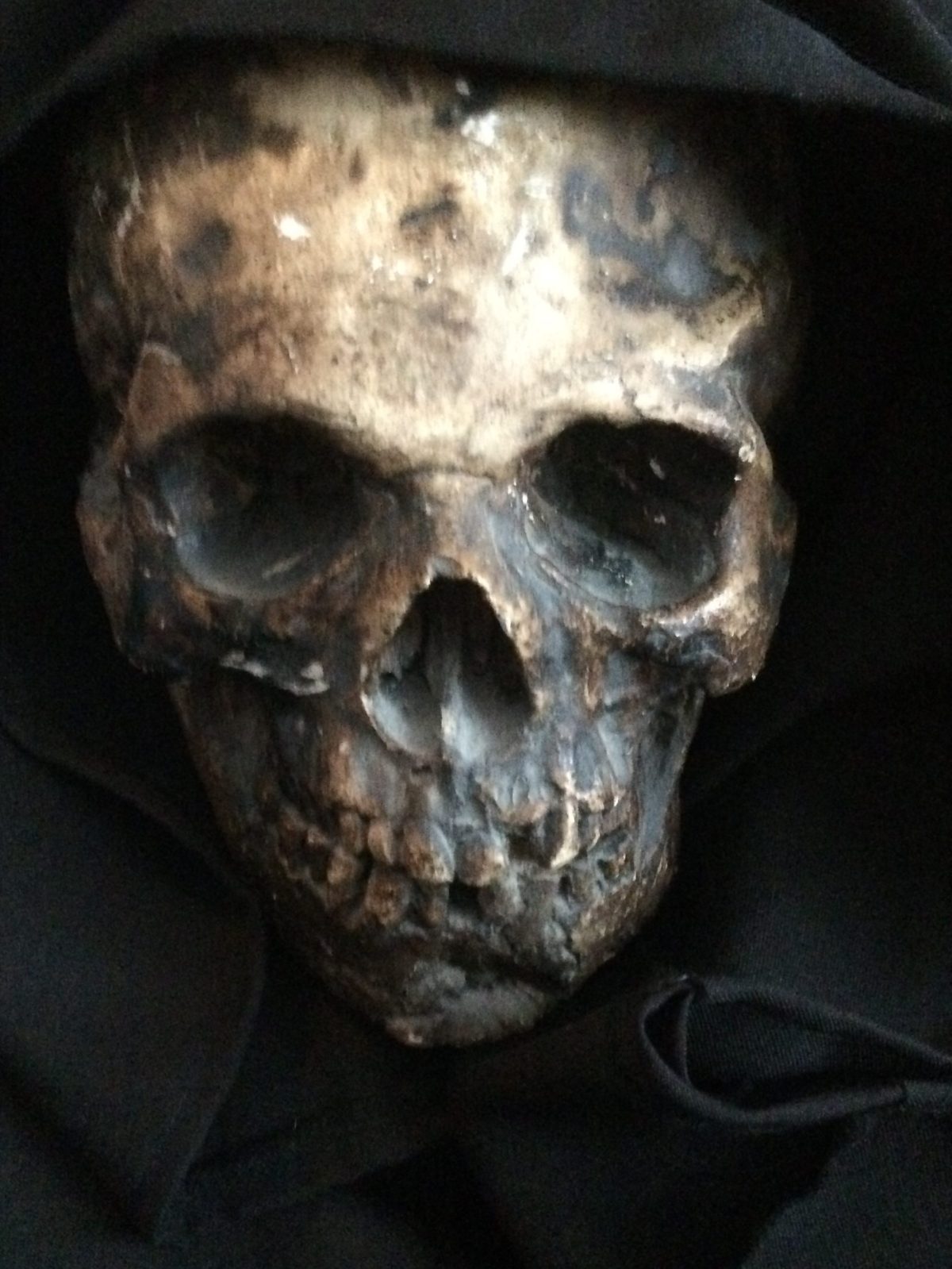
Alas, Not Dickie, just my own personal skull

A mutual acquaintance of David and mine subsequently told us that his girlfriend used to borrow Dickie’s Skull from its owners in the 1970s, much to his astonishment (she obviously wasn’t too concerned about the legendary consequences). As one of the few people still alive who has handled the skull, he remembered that it felt and looked rather small, more like a child’s skull rather than an adult. Our acquaintance has handled quite a few skulls over the years as part of his work in archaeology and it’s a memory that has stayed with him for over forty years.

So there’s an end to the legend, albeit not a very happy or satisfactory one. David and I agreed that it was understandable that the owners didn’t want the bad bonce in their house but why not pass it to a museum? They could have tested the skull, determined how old it was, its gender, age, cause of death, even where the individual came from or what diet it had. For hundreds of years, the skull was respected, venerated and feared by local people and a museum could have continued the story, replacing some of the myths with forensic science.

Of course, if you know anything more about Dickie’s Skull than we do, especially where it was buried, feel free to contact me or Dr David Clarke and we might be able to bring a more pleasing conclusion to the tale. In the meantime, if you find any human remains, don’t put them on your windowsill to ward away evil spirits, call the police.

Goyt Valley follow up

Thanks to those of you who have commented or sent in your own stories about supernatural hotspot The Goyt Valley. Most notable of contributions was this photo sent in by Chloe Drabble: A phantom interloper photobombs a shot of Errwood Hall at night, when Chloe’s parents visited. Intriguingly,  the figure resembles the one that appeared in my film, shot nearby. It seems that the otherworldly residents of The Goyt are very keen to get in on the action! Click here for the original article.

chloe's photo


Grinlow Woods – again!

Grinlow in Buxton continues to be my local supernatural hotspot with this photo, kindly sent in by a nice man called Kevin. Visiting for the day, Kevin took this shot of his daughter on the approach to Solomon’s Temple, a Victorian folly that crowns Grinlow’s highest point. Not a particularly unusual image until you spot the monk-like figures behind the tree in the background. After noticing the spectral photo bombers, Kevin searched the web and found my original post about sinister figures at Grinlow. The ascent through the woods to Solomon’s Temple is a popular walk but Kevin mentioned that there wasn’t anyone else around at the time. At least, no one that belongs to this world.

kevin's monk

If the photo wasn’t creepy enough, it is a lesser known fact that Grinlow was actually an ancient burial site. As the skull in the local museum will testify, the foundation of Solomon’s Temple is a Bronze Age barrow that contained the remains of a man. The word low is an old English word meaning barrow or burial mound. However, this is only significant if you subscribe to the belief that ghosts are the lingering spirits of the deceased. I’ve never been terribly convinced, especially after my conversation with seasoned ghost hunter Wesley H. Downes although I remain open-minded.

grinlow skull

D.W.


Wolfson Investigates: Skellybob Wood

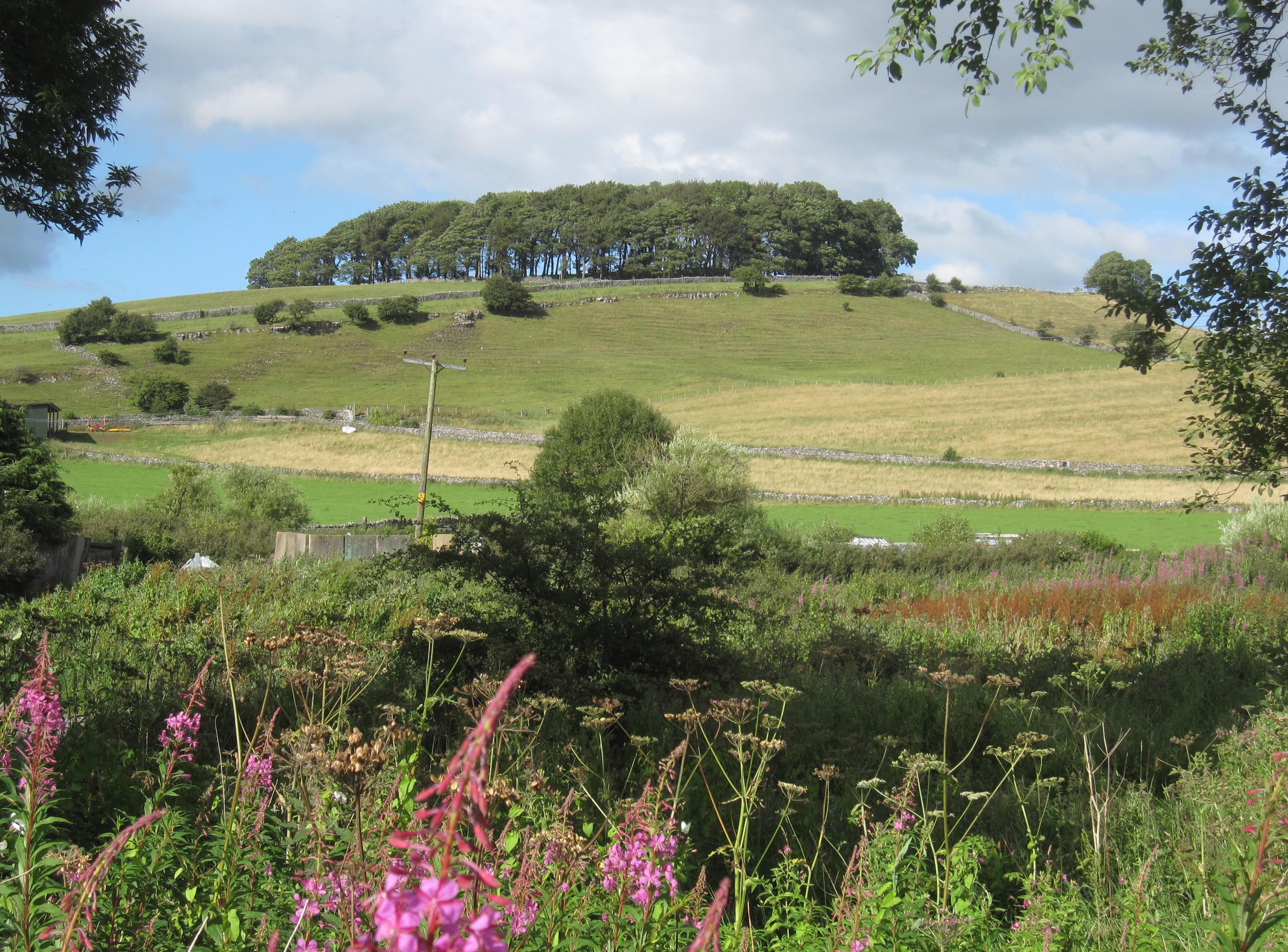
One of the creepiest spots in my hometown of Buxton, Derbyshire is also one of the most mysterious. Overlooking the northern edge of the town is a damaged Bronze Age burial mound called Fairfield Low. You could be forgiven for missing it; despite occupying one of the highest points in Buxton, it is encircled by a thick crown of trees on private farm land. Some locals are aware of its existence but know it as Skeleton Wood or Skellybob Wood (whatever a skellybob is!)

IMG_7804

Local antiquarian Micah Salt excavated Fairfield Low in 1895 on the night before Halloween. He discovered human remains, noting that the sight had been previously disturbed, probably by lime burners. The skull now sits on the desk in the town museum’s Boyd Dawkins study. It belonged to a man who died in middle age. It seems likely that Micah Salt’s morbid discovery is the culprit for the location’s eerie nickname.

img_2980

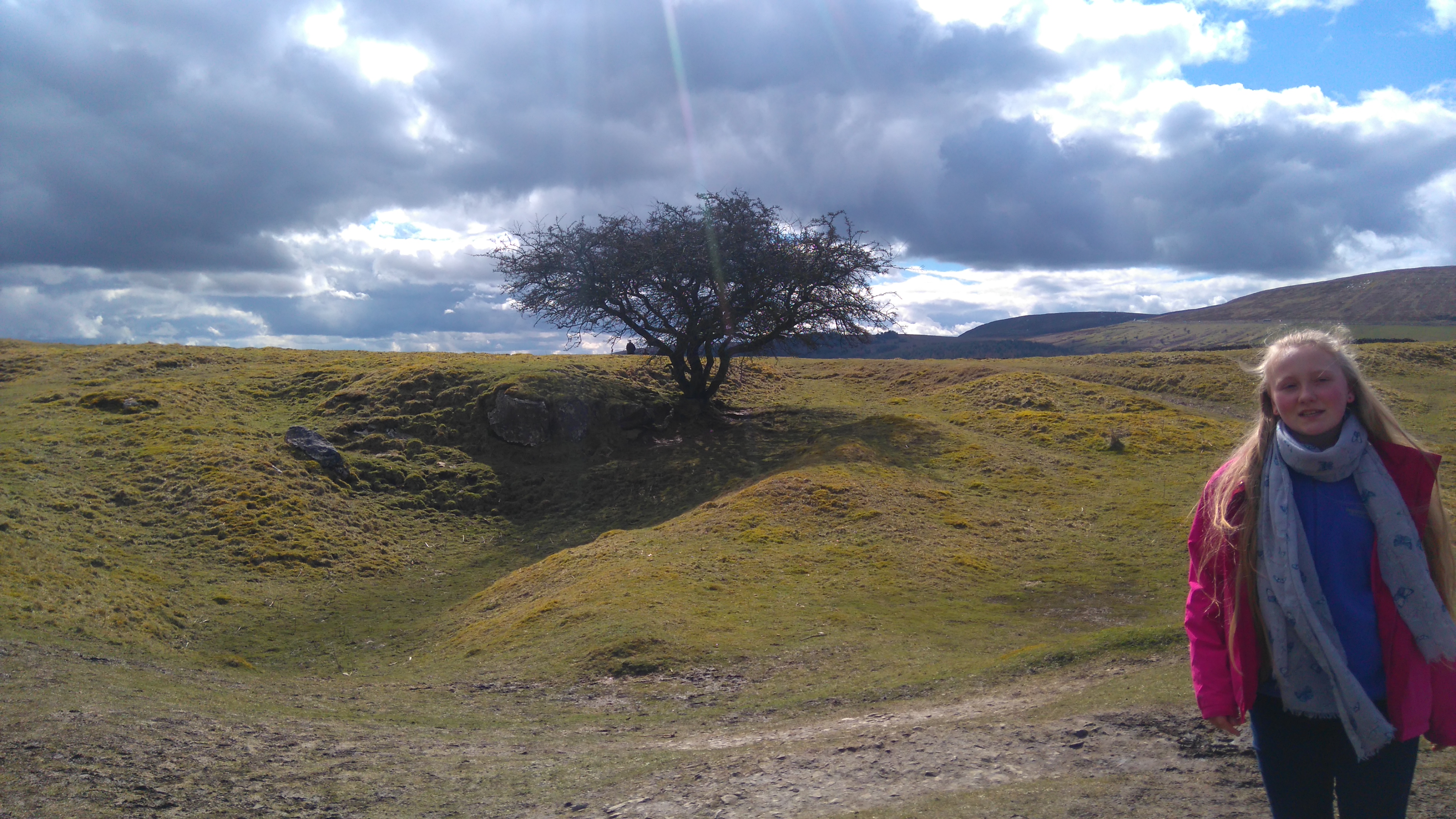
Intrigued, I set off to investigate the sinister place for myself. The summer of 2015 has been generally cold and wet in these parts, hardly like a summer at all. As you can see by my companion’s photographs, it was my good fortune to enjoy an uncommonly warm and sunny day.

Most of modern-day Fairfield is a vast labyrinth-like housing estate and it is easy to get lost unless you know your way around. Quizzing several residents as to the whereabouts of Fairfield Low did not help. As I’ve already mentioned, they call it Skellybob Wood. I focused my attention on the trees on the highest hill, rising above the multitude of rooftops. Finding it was not impossible. Getting to it was a different matter!

IMG_7805
Note unfortunate position of umbrella

Stumbling onto the right path was sheer luck. There are no sign posts and the first part winds its way round the back of a large industrial estate and through a maze of allotments. Here we encountered an elderly lady who had heard of Fairfield Low but by this point we were in its shadow. The lady was perturbed by the gun I was carrying. I explained that it was actually an umbrella.

There is no public access to Skeleton Wood and by climbing a couple of walls, we were technically trespassing (apologies to the owner). The cows that know the wood as home did not seem particularly impressed that we were there. One bovine occupant in particular had the most intimidating stare I’ve ever seen on an animal; so much so that we felt compelled to circumvent it. Even when we reached the tree line, we discovered further resentment from a group of tracksuited teenagers who were loitering around in the wood.

IMG_7833

Despite the opposition, I was pleased to find myself in the footsteps of Micah Salt, on top of what was clearly a burial mound. The ancient tomb is so well hidden by the trees, it is impossible to see it until the final ten metres of the climb. There is a deep gouge into the hillock. Whether this is the product of Salt’s excavation, the work of lime burners or a more supernatural disturbance is unclear. Skeleton Wood certainly has a very tangible and peculiar atmosphere. The warmth of the sun is replaced by a chilly breeze that gently rustles the leaves. The trees are old and twisted and command a solemn reverence, like graves in a churchyard.

IMG_7850

We felt no need to linger but before departing, I noted the unfamiliar view out towards Dove Holes. Dotted around the landscape are several other mounds that looked suspiciously man-made. The Neolithic henge called The Bull Ring is in that direction too. It strikes me that there was a lot of activity in this area thousands of years ago. The hills and dales evidently resonated with significance for our ancient ancestors. Standing here, I can’t help but wonder who they were and what they would think now, looking upon the sprawl of Fairfield estate. In Skeleton Wood, their ghosts linger, whispering forgotten secrets amongst the trees.

D.W.

Photos by Jen Francis of Explore Buxton

Wolfson Investigates: A Brocken Spectre

Until recently, I knew nothing about the phenomenon commonly known as a Brocken Spectre. My good friend Bryn Layton had the good fortune (and skill) to photograph one and I was immediately fascinated.  The “spectre” is created under particular atmospheric conditions. The ghostly outline of a person is reflected onto low cloud or fog when they are stood infront of the sun on a high ridge or mountain. In this case, at 8am on Mam Tor in the Peak District in the UK.

Copyright Bryn Layton

Once explained, the circumstances seem a little mundane but the effect is nonetheless spectacular. The halo around Bryn’s reflection is reminiscent of a religious icon and makes you ponder the origin of such imagery. Would our ancient ancestors have perceived their own reflection or would they have seen something uncanny; a being from another world or even a god?

Back for Halloween!

D.W.